

Condividi
A tennis tournament has unusual rhythms. Some days are spent at the club from start to finish, while on others a window of a few hours opens between one session and the next. If you are coming to Bari for the Levante Open, that time can be enough to see part of the city without turning tournament week into a race against the clock.
The idea behind this guide is simple: always start with the match schedule and build everything else around the tennis. Not the other way around. The Levante Open runs from 28 September to 4 October at Circolo Tennis Bari; match times and the order of play can change, so before leaving the venue it is always worth checking the latest schedule.
If you have limited time: Bari Vecchia is the most complete option
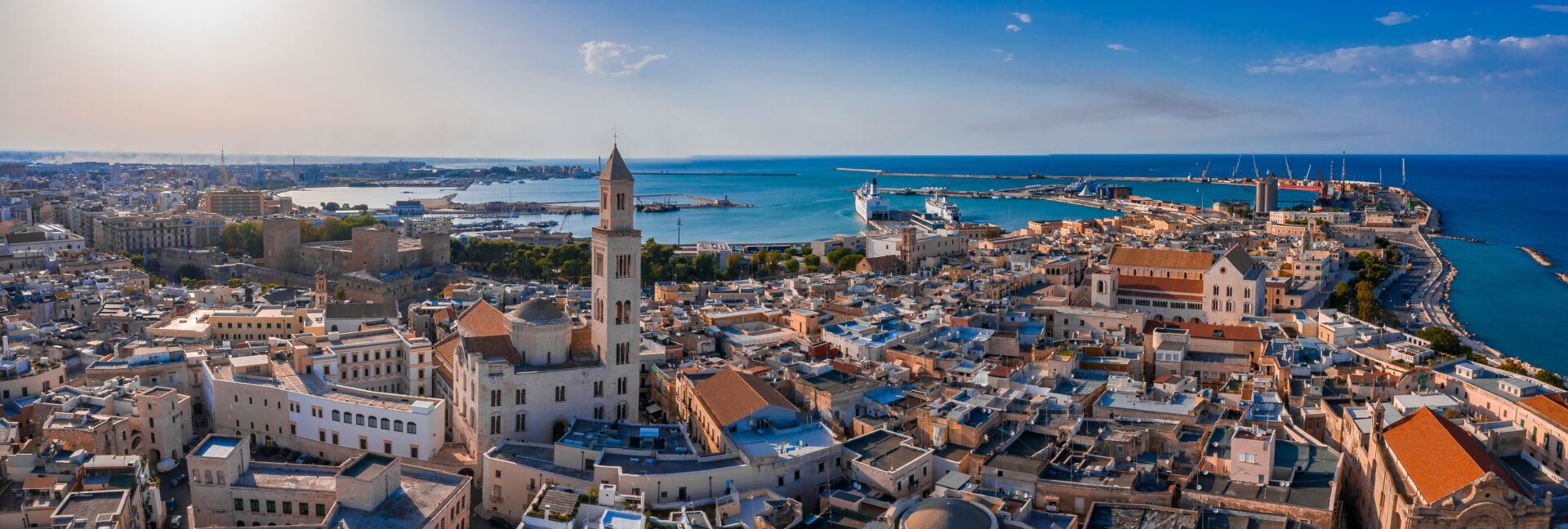
When time is tight, the historic centre brings many things together in a relatively compact area. Bari Vecchia is the city’s old quarter, set between the two harbours and enclosed by the old walls. Some of the places that best explain Bari can be found here without the need to create a complicated itinerary.
A walk can begin at Piazza del Ferrarese and Piazza Mercantile, continue through the lanes of the old town and reach the Basilica of Saint Nicholas. In between is the most recognisable side of the city: pale stone, courtyards, arches, votive shrines and streets that are still lived in, not merely visited.
The national tourism portal Italia.it describes Bari Vecchia as the San Nicola district and notes that its historic fabric includes dozens of churches and votive shrines. It is a good starting point for anyone visiting the city for the first time.
The Basilica of Saint Nicholas is more than a postcard stop
The Basilica of Saint Nicholas is worth spending time in even if religious tourism is not your focus. It is one of the places that best explains Bari’s relationship with the Mediterranean and Eastern Christianity. The relics of Saint Nicholas are kept in the crypt, and the sanctuary is a destination for both Catholics and Orthodox Christians.
Construction of the Basilica began at the end of the 11th century and the building is one of the landmarks of Apulian Romanesque architecture. If you have only a couple of free hours, it is one of the places worth actually entering rather than simply photographing from outside.
Before visiting, it is still advisable to check the latest opening hours, especially if the tournament schedule leaves you only a narrow window.
Norman-Swabian Castle: a short walk from the old town
On the other side of the historic centre stands the Norman-Swabian Castle. Its main structure was transformed by Frederick II in the 13th century over earlier fortifications; in later centuries the complex changed again, including additions from the Aragonese period.
It works well as a stop precisely because it can be combined with Bari Vecchia without building a second day around it. If time is short, you can simply see it from outside; with a larger window, an interior visit is worth considering.
The page dedicated to the Castle of Bari on Italia.it provides the essential historical information about the complex.
The seafront when you simply need a break
Not every break has to become a guided tour. After hours in the stands, sometimes a walk is enough.
The Bari seafront is probably the simplest choice when you want to see the city without entering museums or following a fixed route. The sea accompanies a significant part of the urban centre and provides an ideal link between the old town and modern Bari.
It is also a good option at the end of the day, when there is no longer a match to chase and you can let Bari set the pace. In that case, there is no need for a list of monuments: a little time before dinner is enough.
The Murat district and Teatro Petruzzelli: Bari beyond the old town
Stopping only in the historic centre gives an incomplete picture of the city. Just outside the old walls everything changes: regular streets, 19th-century buildings and the Murat district, developed as part of the expansion of modern Bari.
One of the landmarks here is Teatro Petruzzelli. Even without attending a performance, the area reveals another side of Bari and works well for a walk through Corso Cavour, Via Sparano and the city’s commercial heart.
If you have already visited Bari Vecchia on an earlier day of the tournament, this is probably the best choice for a second short outing.
Orecchiette, yes — but without turning them into scenery
Among Bari’s most photographed places is now the Arco Basso area, made famous by the preparation of orecchiette outside local homes. It is a genuine tradition, but also a lived-in space. It is worth visiting with the curiosity appropriate to a real neighbourhood, not as though it were a set created for visitors.
The same applies to food. Focaccia barese, panzerotti, sgagliozze and seafood cooking are all part of the city’s experience, but during a tournament week there is no need to build a gastronomic checklist. It is better to choose one good break than chase ten different addresses.
One hour, three hours or half a day: what makes sense
Your free time during the Levante Open will depend above all on the order of play. It can therefore be more useful to think in time windows than in ideal days.
- About one hour: a walk along the seafront or through the modern centre, without planning any admissions.
- Two or three hours: Bari Vecchia, the Basilica of Saint Nicholas and a walk to the Castle.
- Half a day: the historic centre at a slower pace, the Castle or another cultural visit, the Murat district and the seafront.
- A free evening: Bari Vecchia, Piazza Mercantile, the seafront and dinner in the centre.
These are not travel times from Circolo Tennis Bari, but the amount of time to devote to the visit once you have reached the city centre. Traffic, parking and travel can vary considerably depending on the time of day, so it is better not to plan an excursion with margins that are too tight between two matches.
The tournament schedule comes first
During the Levante Open, the most practical advice is also the least tourist-oriented: do not decide in the morning that you will definitely be in the city centre at 4 p.m. if you are following a match that could start later than expected.
In tennis, the previous match can run long, a “Not Before” time is not a guaranteed start time, and the day’s order of play has to be read as a whole. If you are following a specific player, always leave enough time to return to the club.
For schedule, results, draws and official references, we have prepared the guide How to follow the Levante Open 2026.
Bari does not have to fit entirely into one week
Anyone coming for the tournament may be tempted to see everything. It is understandable, but not realistic. Bari works better if you choose one part of the city and explore it without rushing: a morning in Bari Vecchia, an evening on the seafront, a walk through the Murat district.
The Levante Open remains the reason for the trip. The city does not need to compete with the tournament for your time; it can do something better: fill the spaces between matches well.